Lawrenceville was incorporated Dec. 15, 1821, and is Gwinnett's county seat. Its National Register landmarks, museums and historic cemetery, with dates.
Last checked Oct. 6, 2026. Sources: the City of Lawrenceville’s History of Lawrenceville and Historical & Military Sites pages, the National Park Service’s National Register of Historic Places data (file of May 22, 2026), the Gwinnett Historical Society and the state historical marker at the seminary. Gwinnett Historical Society: 770-822-5174.
Lawrenceville was incorporated on Dec. 15, 1821, exactly three years after Gwinnett County was formed, and it is the county seat, the oldest city in Gwinnett and, the city says, the second-oldest city in metro Atlanta. It is named for Capt. James Lawrence, the War of 1812 naval commander who told his crew “not to give up the ship,” according to the city’s history page.
Who to call
- Gwinnett Historical Society: 770-822-5174, Room 210, Gwinnett Historic Courthouse, 185 W. Crogan St.; open 10 a.m. to 2 p.m. Monday, Wednesday and Friday
- Gwinnett Historic Courthouse events and rentals: 770-822-5450
- Freeman’s Mill Park historic information: 770-822-5178
- City of Lawrenceville: 770-963-2414
A timeline from the city’s history
| Year | What happened |
|---|---|
| 1821 | Lawrenceville incorporated, Dec. 15 |
| 1824 | First courthouse built on the square, chosen for nearby springs |
| 1838 | Lawrenceville Female Seminary opens, Sept. 24 (state marker) |
| 1853-1855 | The present Greek Revival seminary building is built (state marker) |
| 1871 | Fire destroys the original courthouse; the city’s first public well is dug |
| Late 1800s | The railroad arrives, making Lawrenceville a freight and passenger hub |
| 1903 | First power plant built |
| 1929 | U.S. 29, the first paved road, reaches town |
| 1944 | Mack Renwick donates three acres on Neal Boulevard for a school for Black students |
| 1951 | The city’s Natural Gas Department is created; the brick Hooper-Renwick School is built |
| 1966 | First runway at what became Briscoe Field |
| 1968 | Hooper-Renwick closes with desegregation |
| 1988 | The Gwinnett Justice and Administration Center replaces the old courthouse |
| 2006 | Georgia Gwinnett College opens |
| 2011 | Judy Jordan Johnson becomes the first woman elected mayor |
| 2020 | The city sells its water system to Gwinnett County |
After the 1871 fire, the Romanesque courthouse that stands today was built in its place to a design by a Boston architect the city names as “EG Lin.” The city’s page gives no completion year; we will add it when we can source it.
National Register of Historic Places
The National Park Service lists these properties with a Lawrenceville address:
| Property | Address | Listed |
|---|---|---|
| Old Seminary Building (Lawrenceville Female Seminary; old Masonic lodge) | Perry Street | Dec. 29, 1970 |
| Gwinnett County Courthouse | Courthouse Square | Sept. 18, 1980 |
| Clarence R. Ware House | 293 N. Perry St. | June 17, 1982 |
| William Terrell Homeplace | East of Lawrenceville off U.S. 29 | Aug. 26, 1982 |
| Robert Craig Plantation | 1504 Five Forks Trickum Road | June 8, 1990 |
Nearby: Freeman’s Mill in Freeman’s Mill Park, 1401 Alcovy Road, is listed as the Alcovy Road Grist Mill with a Dacula address, on July 23, 1998. Brothers John Griffin and Levi J. Loveless built the mill between 1868 and 1879, according to the city, and the county restored it in 2009.
Landmarks you can visit
Gwinnett Historic Courthouse, 185 W. Crogan St. The 2.5-acre courthouse square is free to visit, the city says, with a burial monument dedicated in 1840 to veterans of the Creek Indian and Mexican wars, the Gwinnett County Civil War Monument, the Gwinnett County Veterans Museum inside the courthouse, the Gwinnett Historical Society’s exhibits, a monument to world heavyweight boxing champion Ezzard Charles, and historical markers for Bill Arp, Garrard’s Cavalry Raid and Button Gwinnett (city page). The small corner balcony was used to summon jurors from the square until 1988.
Lawrenceville Historic Cemetery, about half a mile from the square between East Pike Street and U.S. 29. Gwinnett founders William Maltbie and Elisha Winn and the first mayor, John Clay Smith, are buried here, as is Revolutionary War veteran Nathan Spence (1743-1833). Eight graves are identified as Confederate soldiers’. The city notes many unmarked graves of African Americans not yet identified. Free (city page).
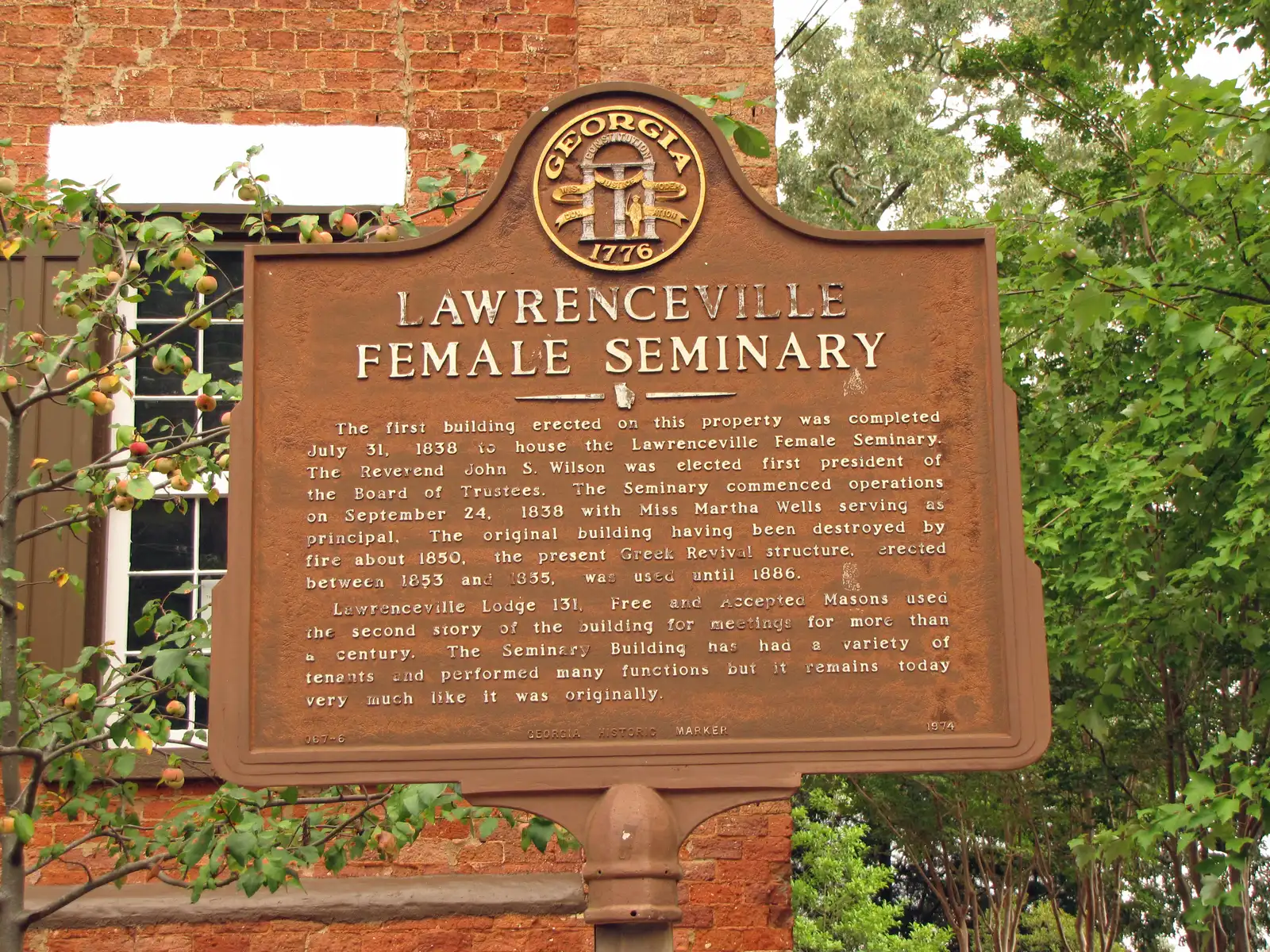
Lawrenceville Female Seminary, Perry Street. The 1974 state marker says the first building was finished July 31, 1838, the seminary opened Sept. 24, 1838, with Martha Wells as principal, and the present building replaced one lost to fire about 1850. It served the seminary until 1886, and Lawrenceville Lodge 131 of the Masons met upstairs for more than a century.
Hooper-Renwick School site, Neal Boulevard. Rocky Knob School served Black students from 1885 until a tornado destroyed it in 1924. The 12-classroom Hooper-Renwick building of 1951 served Gwinnett’s Black students until 1968. The city and county agreed in December 2020 to turn it into a themed library about segregation and desegregation in Gwinnett (city page); it is now the Hooper-Renwick branch of the Gwinnett County Public Library.
Heritage Trail. Medallions downtown honor people who shaped the city, from the Fallen Heroes Memorial at 75 Langley Drive to Rhodes Jordan Park; see our walking and biking trails page.
Ghost stories and tours
Aurora Theatre’s Lawrenceville Ghost Tours and Haunted Cemetery Tours retell downtown’s legends each fall; see Halloween events.
What this means for you
- Start at the courthouse square: monuments, markers and the veterans museum, free.
- The Historical Society is open three days a week, 10 a.m. to 2 p.m.
- Five Lawrenceville properties are on the National Register; three are downtown.
More: downtown Lawrenceville and population and growth.
Frequently asked questions
When was Lawrenceville, Georgia, founded?
Lawrenceville was incorporated on Dec. 15, 1821, three years to the day after Gwinnett County was formed, according to the city. It is the county seat and the oldest city in Gwinnett.
Who is Lawrenceville named after?
Capt. James Lawrence, the War of 1812 naval commander remembered for the order not to give up the ship, the city says.
What buildings in Lawrenceville are on the National Register of Historic Places?
The Old Seminary Building (listed 1970), the Gwinnett County Courthouse (1980) and the Clarence R. Ware House (1982), plus the William Terrell Homeplace (1982) and the Robert Craig Plantation (1990) outside downtown, according to the National Park Service.
Is the Gwinnett Historic Courthouse open to visitors?
Yes. The grounds, monuments and markers are free to visit, the city says, and the Gwinnett Historical Society’s office on the second floor is open 10 a.m. to 2 p.m. Monday, Wednesday and Friday.
Have your say