Lawrenceville's jobless rate was 3.6% in September, up from 3.3% a year earlier and above Gwinnett County's 3.3%, even as 260 more residents had jobs.
Lawrenceville’s unemployment rate was 3.6% in September, up from 3.3% in September 2025. It was the city’s highest rate in a year, matching June.
More city residents had jobs than a year earlier, about 260 more. But the labor force grew faster, so about 60 more people were out of work and looking.
The figures are the preliminary September estimates from the U.S. Bureau of Labor Statistics’ Local Area Unemployment Statistics program, published this week. The BLS publishes a separate rate for the city of Lawrenceville, not only for Gwinnett County. The figures are not seasonally adjusted, so the fair comparison is with the same month a year earlier.
Lawrenceville against its neighbors
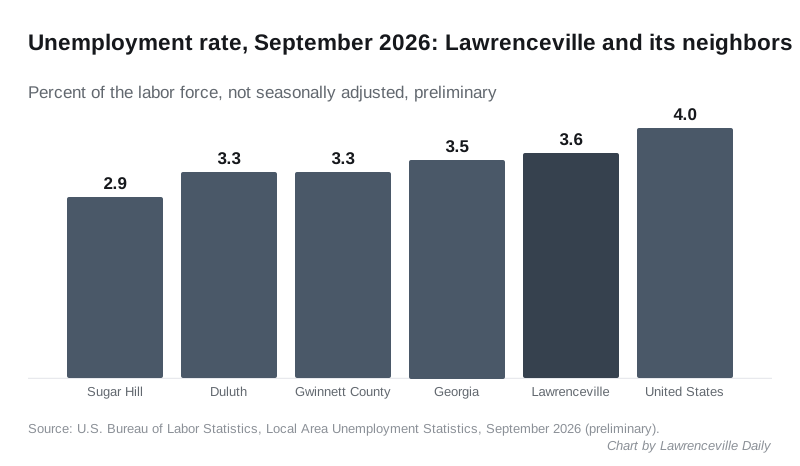
| Area | September 2026 | September 2025 | August 2026 |
|---|---|---|---|
| Sugar Hill | 2.9% | 2.7% | 2.8% |
| Duluth | 3.3% | 3.2% | 3.1% |
| Gwinnett County | 3.3% | 3.2% | 3.2% |
| Georgia | 3.5% | 3.4% | 3.4% |
| Lawrenceville | 3.6% | 3.3% | 3.4% |
| United States | 4.0% | 4.3% | 4.3% |
All rates are not seasonally adjusted. Sources: BLS series for Sugar Hill, Duluth, Gwinnett County, Georgia and the United States.
Lawrenceville’s rate was above the Gwinnett County and Georgia rates. It was below the national rate of 4.0%.
Duluth, about 10 miles west, matched the county at 3.3%. Sugar Hill, about 10 miles north, was lowest at 2.9%. The BLS does not publish a monthly rate for Dacula, Snellville, Suwanee or Lilburn, which are too small for its city series.
Lawrenceville’s rate rose 0.3 points on the year, the biggest rise in the table. Sugar Hill rose 0.2 points. Duluth, the county and the state each rose 0.1 points. The national rate fell 0.3 points.
The numbers behind the rate
In Lawrenceville in September, according to the BLS:
- 16,508 people were in the labor force, up from 16,188 a year earlier.
- 15,915 people had jobs, up from 15,655.
- 593 people were unemployed, up from 533.
Across Gwinnett County, 514,227 residents had jobs in September, up from 505,817 a year earlier. The county’s unemployed count was 17,816, up from 16,736.
The labor force counts people who have a job or are looking for one. The unemployment rate is the share of the labor force without a job and looking for one. These are counts of residents, wherever they work. They are not counts of the jobs located in the city.
For a city of Lawrenceville’s size, the monthly numbers are estimates and can swing. A change of 60 people moves the city’s rate by about 0.4 points.
The past year, month by month
Lawrenceville’s rate moved between 2.5% and 3.6% over the year. It was lowest in April and highest in June and September.
| Month | Lawrenceville rate |
|---|---|
| September 2025 | 3.3% |
| October 2025 | not published |
| November 2025 | 3.4% |
| December 2025 | 3.5% |
| January 2026 | 3.5% |
| February 2026 | 3.5% |
| March 2026 | 3.4% |
| April 2026 | 2.5% |
| May 2026 | 2.9% |
| June 2026 | 3.6% |
| July 2026 | 3.4% |
| August 2026 | 3.4% |
| September 2026 | 3.6% (preliminary) |
Because the figures are not seasonally adjusted, a change from one month to the next can reflect the season, not a change in the job market. In August, the city’s rate of 3.4% was down from 3.6% in August 2025.
There is no October 2025 figure. The BLS lists the month as “data unavailable due to the 2025 lapse in appropriations,” the federal government shutdown that fall.
What it means for you
- If you are looking for work, the Georgia Department of Labor’s EmployGeorgia job board lists openings in and around Lawrenceville.
- The September numbers will change. The BLS marks the latest month as preliminary and revises it the following month.
- October’s figures for the city come in the next BLS monthly release. We will update this story when they are out.
- For more on the local economy, see our pages on new businesses and home prices.
Have your say